We like reading industry reports, but as we read we never stop asking “what does this mean on our shop floor?”. This post is a short summary of three topics in robotics that look important to us going into 2026, and what each of them means on the shop floor.
The numbers: half a million robots a year is now normal
According to the International Federation of Robotics (IFR) World Robotics 2025 report, 542,076 industrial robots were installed worldwide in 2024. That is more than double the figure of ten years earlier, and the fourth year in a row that annual installations have stayed above 500,000. Asia accounted for 74% of installations and Europe for 16%. Collaborative robots (cobots) grew 12% to 64,542 units, taking their share of the total to 11.9%.
- industrial robots, 2024
- 0,076industrial robots, 2024
- installed in Asia
- 0%installed in Asia
- cobots, 12% growth
- 0,542cobots, 12% growth
- cobot share
- 0.9%cobot share
The report, in motion
01 / 05
2024 installations
542,076 industrial robots installed worldwide; above 500,000 for the fourth year in a row.
02 / 05
Double in ten years
Annual installations are more than double the level of ten years earlier.
03 / 05
Regions
74% of installations in Asia, 16% in Europe.
04 / 05
Cobot share
64,542 units and 12% growth: cobots now make up 11.9% of the total.
05 / 05
Timeline
ISO 10218 was revised in February 2025; the EU Machinery Regulation applies from 20 January 2027.
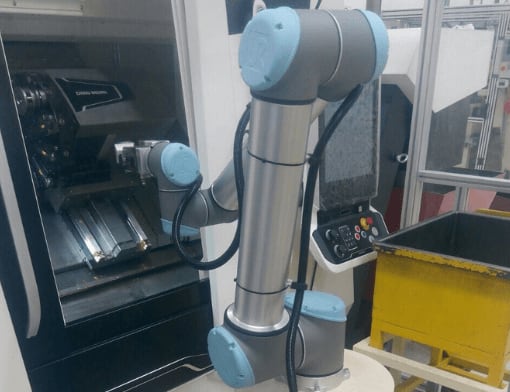
On the shop floor: robots are no longer a “big factory” topic. The cobot share rising every year shows that mid-sized workshops wanting no more than one arm at a single machine are starting to come in too. The cobot cell we built for CNC machine unloading fits exactly that profile: one machine, one arm, and the operator moved on to the next machine.
ISO 10218:2025: a cobot is no longer a type of robot, but a property of the application
Parts 1 and 2 of ISO 10218, the safety standard for industrial robots, were revised in February 2025: the first major revision since 2011. The most important change is conceptual: collaborative operation is now a property of the application, not of the robot. So under the standard, “I bought a cobot, so it’s safe” means nothing; the gripper, the product, the speed and where the person is are assessed together. The collaborative requirements previously in ISO/TS 15066 have largely moved into Part 2, and robot classes with their associated functional safety requirements, safety-related cybersecurity and guidance on end effectors (grippers) have been added.
On the shop floor: we carry out the risk assessment per cell, not per robot. The edge of the gripper, the weight of the part being carried and the operator’s access point are all part of the document. On new installations, writing it this way from the start is far cheaper than documenting it all over again later.
EU Machinery Regulation 2023/1230: 20 January 2027
On 20 January 2027, Machinery Regulation (EU) 2023/1230 replaces the Machinery Directive 2006/42/EC. Unlike the directive, the regulation applies directly; cybersecurity becomes part of machine safety, and digital documentation becomes possible. Listing ISO 10218:2025 in the Official Journal of the EU is a precondition for the standard to have full legal effect under the regulation; once that process is complete, it will in practice be mandatory for access to the European market.
On the shop floor: for every machine builder that exports, 2026 is the year of documentation. On the machines we build ourselves (sandblasting machines, press brakes, goods lifts) we are updating the technical file to the regulation; on the robot cells we integrate, we document the safety PLC and the network architecture together with cybersecurity.
And humanoids?
Plenty in the headlines, none on the shop floor yet. The robots doing real work in factories today are six-axis arms, SCARAs and mobile platforms. We follow humanoid projects with interest, but what we would recommend to a customer today is a boring six-axis arm with the right gripper and the right safety design. Boring, because it works.
Sources: IFR World Robotics 2025 (September 2025 press release); ISO 10218-1/-2:2025; Regulation (EU) 2023/1230. Figures are as of the report’s publication date.